
4 Reverse Mortgage Qualifying Questions Families Ask: Existing Mortgages, Equity, Income & Buying a New Home

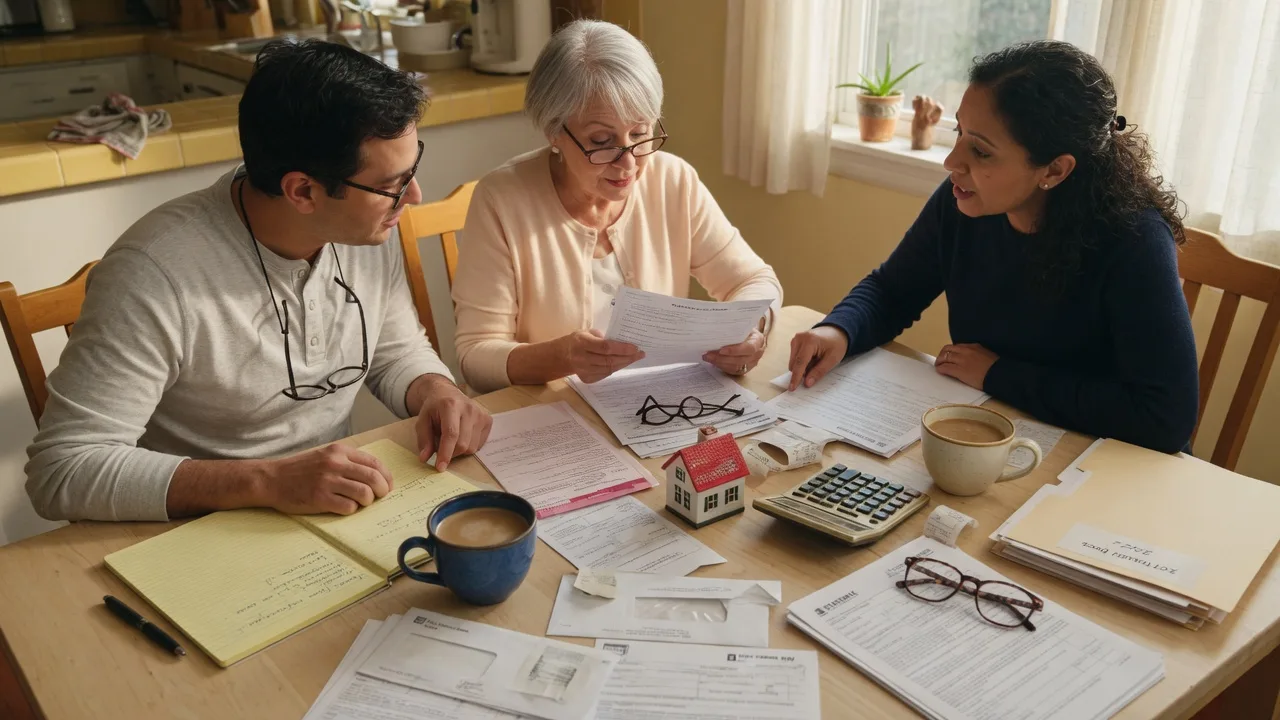
Meet Dana. Her parents, Walt and Carol, are 78 and 74, they still owe about $85,000 on their longtime home in the Phoenix area, their income is modest, and the house has a staircase that is starting to feel dangerous. Dana has heard that reverse mortgages require no monthly payments, but she is not sure her parents would even qualify. Can they get one while they still owe? Do they have enough equity? Will their income and credit pass muster? And if the old house no longer works, could a reverse mortgage help them buy a better one? These are the four questions families ask me most, so here are the current, researched answers.
1. Can Parents Get a Reverse Mortgage If They Still Owe on Their Current Mortgage?
Yes, and it is actually the most common situation I see. A borrower must be at least 62, but there is no rule that the home be owned free and clear. If your parents still owe on a mortgage, a HELOC, or any other lien, the proceeds of the Home Equity Conversion Mortgage, or HECM, must pay that balance off in full at or before closing. HUD requires the reverse mortgage to become the first, and only, lien on the property, so the old debt has to be cleared before the new loan steps into place.
That payoff is the first use of the money. After the existing mortgage is paid off, along with closing costs and any required set-asides, the remaining proceeds are theirs to use however they choose, and there is no monthly mortgage payment from that point forward. For Dana's parents, roughly $85,000 still owed against a home worth about $500,000 is well within reach.
The catch is that parents need enough equity for the HECM proceeds to cover the payoff plus costs, which leads directly to the next question.
2. How Much Home Equity Do Parents Need?
There is no fixed minimum equity percentage written into the HECM rules. The real test is simpler: the loan amount your parents qualify for, called the principal limit, must be large enough to cover the existing mortgage payoff, the closing costs, and any required set-asides. If it is not, they would have to bring cash to closing to make up the difference.
In practice, most lenders look for families to hold roughly half or more of the home's value in equity, though the working number depends on age and rates. The principal limit is built from four inputs: the appraised value, the age of the youngest borrower, the expected interest rate, and the FHA lending limit, which is $1,249,125 for case numbers assigned in 2026. The home's value is capped at that ceiling, so a property worth more does not add to the loan.
Age matters a great deal here. A 62-year-old borrower, the minimum age, typically sees a principal limit factor of roughly 40 to 48 percent of the home's value, while parents in their late 70s and 80s can qualify for 60 percent or more. The younger the youngest borrower, the larger the equity cushion the family generally needs. For Walt and Carol, with about 85 percent equity after their remaining mortgage, the equity side of the question is comfortably settled.
3. What Income and Credit Do Parents Need to Qualify?
This is the question that surprises most families, because a reverse mortgage does not require a job or a specific income level, and there is no minimum credit score. What the program requires instead is something HUD calls a financial assessment, in place since 2014, and it has two parts.
The first part is a credit review that looks at a willingness to pay: housing and installment debts paid on time over the past year, and no major derogatory credit in the recent past. The second part is a residual income review that verifies income from Social Security, pensions, retirement accounts, and other sources, then compares it against ongoing obligations, including the property taxes and homeowners insurance parents must keep current. The amount left over, called residual income, must meet a HUD table based on household size and region.
Here is the reassuring part for families who are worried about past medical bills or a bruised credit record. The assessment looks forward, not backward. If residual income comes up short, two levers can close the gap: documented compensating factors, such as meaningful savings, or a Life Expectancy Set-Aside, a portion of the loan proceeds held back to cover taxes and insurance over the borrower's expected lifetime. Walt and Carol's modest Social Security and pension income, with no car payment and small credit card balances, would likely pass, and their savings give them room even if the numbers are tight.
4. Can Parents Use a Reverse Mortgage to Buy a New Home (HECM for Purchase)?
Yes, through a program called HECM for Purchase, created by Congress in 2008. It lets a borrower 62 or older buy a new primary residence without required monthly mortgage payments, which makes it a genuinely useful tool when the family home no longer fits.
The mechanics are different from a traditional purchase. Your parents bring a substantial down payment from the sale of their current home, savings, retirement funds, or a gift from family, and the HECM loan covers the rest of the purchase price plus closing costs. The required down payment is not a fixed percentage; it is whatever is left over after the principal limit is applied, and in practice it usually lands somewhere in the 40 to 65 percent range of the purchase price, with younger buyers needing a larger share.
The new home must become their principal residence, they complete the same HUD-approved counseling, and they stay responsible for the property taxes, insurance, HOA fees, and maintenance. The property also has to meet FHA standards. For Dana's parents, a HECM for Purchase could mean trading the staircase for a single-story home near their daughter, using the equity from the old house as the down payment, with no monthly mortgage payment to absorb their fixed income.
The Takeaway for Families
What connects these four answers is that qualifying for a reverse mortgage is far more attainable than most families assume. Parents who still owe can use the loan to clear the old mortgage at closing. The equity bar is about the math working, not an arbitrary percentage. There is no income or credit threshold to clear, just a forward-looking financial assessment. And when the current home no longer fits, a reverse mortgage can even be the vehicle for buying the next one.
For Dana, the answer was good news: her parents could very likely qualify, the old mortgage would be paid off at closing, and if the stairs got any harder, they had a path to a better home. Weeks of worry turned into a concrete set of next steps.
If you are running these same questions for your own parents, a conversation costs nothing and can replace anxious guessing with a clear picture of what is possible. That is exactly what I do every day.
Have Qualifying Questions Like Dana's? Let's Talk.
I offer a free, no-obligation consultation to help you and your family understand whether a reverse mortgage is within reach: how an existing mortgage is handled at closing, whether your parents' equity and income are sufficient, how the financial assessment works, and whether a HECM for Purchase could help them buy a better home. I am a Loan Officer at Emery Financial, licensed in California, Arizona, Colorado, Florida, Texas, and Washington, and I have spent my career explaining complex loan processes in plain, reassuring terms.
Schedule a Free ConsultationDisclaimer: This article is for general informational and educational purposes only and does not constitute financial, legal, tax, or mortgage lending advice, and it is not financial advice. Loan programs, interest rates, terms, and conditions are subject to change and vary based on borrower qualifications. Reverse mortgage eligibility requirements apply, including age, occupancy, property, and financial assessment standards. Figures described here, including the 2026 FHA HECM lending limit of $1,249,125, principal limit factors, working equity guidelines, and HECM for Purchase down payment ranges, are based on current HUD, CFPB, and NRMLA guidance as of the publication date and may change; always confirm current terms with a HUD-approved counselor, an elder law attorney, a tax professional, or a qualified loan officer. Adam Heaney, NMLS #283076, is a Loan Officer at Emery Financial, 3432 Via Oporto, Suite 208, Newport Beach, CA 92663.