
3 Practical Reverse Mortgage Questions Families Don't Always Think to Ask

When I speak with adult children researching reverse mortgages for their parents, I notice a pattern. The big-picture questions about losing the home or affecting inheritance get asked right away. But some of the most practical, day-to-day questions often come up later, sometimes after the loan has already closed.
Today I want to cover three topics that families don't always think to ask about upfront. How the payout options really work (and which one might fit your parents' situation best), what happens if Mom needs to be away from home for medical reasons, and whether reverse mortgage funds can pay for home modifications that make aging in place safer and easier.
1. How Can My Parents Receive the Funds?
This is one of the most practical questions families ask, and the answer has more flexibility than most people realize. A Home Equity Conversion Mortgage (HECM) offers several payout options, and the borrower can choose the one that fits their needs best. With an adjustable-rate HECM, you can even combine options.
Lump Sum
A single payment at closing. This is the only option available with a fixed-rate HECM. It works well for families who need a large amount right away to pay off an existing mortgage, cover a major expense, or fund a big home repair. But once it is taken, the remaining line of credit does not grow, so it is not the best choice for families who want flexibility down the road.
Line of Credit
This is the option I find most families gravitate toward once they understand how it works. The borrower can draw funds as needed, whenever they want. And here is the feature that surprises everyone: the unused portion of the line of credit grows over time. It increases at a rate tied to the loan's interest rate, which means the amount available to your parents can actually be larger next year than it is today. They pay nothing on the line until they draw from it.
I tell families to think of it like a financial safety net. You set it up while your parents are healthy, and the funds are there when needed for medical bills, home repairs, or any other expense that comes up.
Tenure Payments
Equal monthly payments that last for as long as at least one borrower lives in the home as their primary residence. Not for a set number of years. For life. This is the option that most directly addresses the fear of running out of money in retirement. Your parents receive a reliable check every month, with no end date, and they never have to repay a cent as long as they remain in the home.
Term Payments
Equal monthly payments for a fixed period chosen by the borrower. For example, $1,200 a month for 60 months. This works well for families who need predictable cash flow for a specific time frame, such as until a spouse begins receiving Social Security or a pension kicks in.
Modified Combinations
With an adjustable-rate HECM, your parents can combine options. A modified tenure plan gives them a smaller monthly payment plus a line of credit. A modified term plan gives them payments for a set period plus a line of credit. This is one of those things that is hard to visualize until you actually sit down and look at the numbers, but it offers enormous flexibility.
Here is a real example I walk through with families. Let us say your parents take a small lump sum at closing to pay off a remaining mortgage balance of $30,000. They set up a line of credit for the remaining available amount, say $80,000, which grows over time. And they start receiving $500 a month in tenure payments to supplement their fixed income. All three from one loan. That is the kind of custom approach that is possible.
2. What Happens If My Parent Needs to Be Away From Home for an Extended Period?
Meet Linda. Her mother, Ruth, is 82 and lives alone in the family home with a reverse mortgage. Last month Ruth fell and broke her hip. She is in a rehabilitation facility now, and the doctors say she may need three to six months of recovery. Linda's first panicked thought was, "Will Mom lose the house because she is not living there?"
This is a common fear, and the answer is reassuring. HUD allows a borrower to be away from the home for up to 12 consecutive months for medical reasons without triggering the loan becoming due. Hospital stays, rehabilitation, nursing care, hospice, or even staying with a family member during recovery all fall under this rule.
The 12-Month Medical Absence Rule
As long as the borrower intends to return home and does so within 12 months, the reverse mortgage stays in good standing. There is no need to notify HUD in advance, but it is a good practice to let the loan servicer know about the absence so the file is documented. If a co-borrower or eligible non-borrowing spouse remains in the home, the loan continues normally with no time limit.
The 6-Month Non-Medical Absence Rule
Non-medical absences have a shorter window. If your parent leaves the home to travel, stay with family in another state, or any other reason unrelated to health, the allowable absence is six months. After that, the loan can be called due. This distinction matters because I have seen families run into trouble when a parent spends the winter in a warmer state without realizing the clock is ticking.
What About Shorter Trips?
For absences of two to six months, the borrower should notify the loan servicer. It is a simple courtesy that ensures the home remains classified as the borrower's primary residence. The servicer may ask for a brief letter explaining the absence and the expected return date, and that is usually sufficient.
I tell families not to let these rules scare them. The reverse mortgage was designed with the reality of aging in mind. Health emergencies happen. Recovery takes time. The program accounts for that. The important thing is to communicate with the servicer and keep records of medical documentation for any extended healthcare-related absences.
3. Can Reverse Mortgage Funds Pay for Home Modifications and Accessibility Improvements?
This may be the most practical question of all, especially for families whose parents want to age in place safely. The short answer is yes. There are no restrictions on how reverse mortgage proceeds are used, and home modifications are one of the most common and valuable uses of the funds.
What Kind of Modifications Qualify?
Because the proceeds can be used for any purpose, families have complete flexibility. Here are some of the most common modifications I see seniors make with reverse mortgage funds:
- Bathroom safety upgrades. Grab bars, walk-in showers, handheld shower heads, raised toilet seats, non-slip flooring.
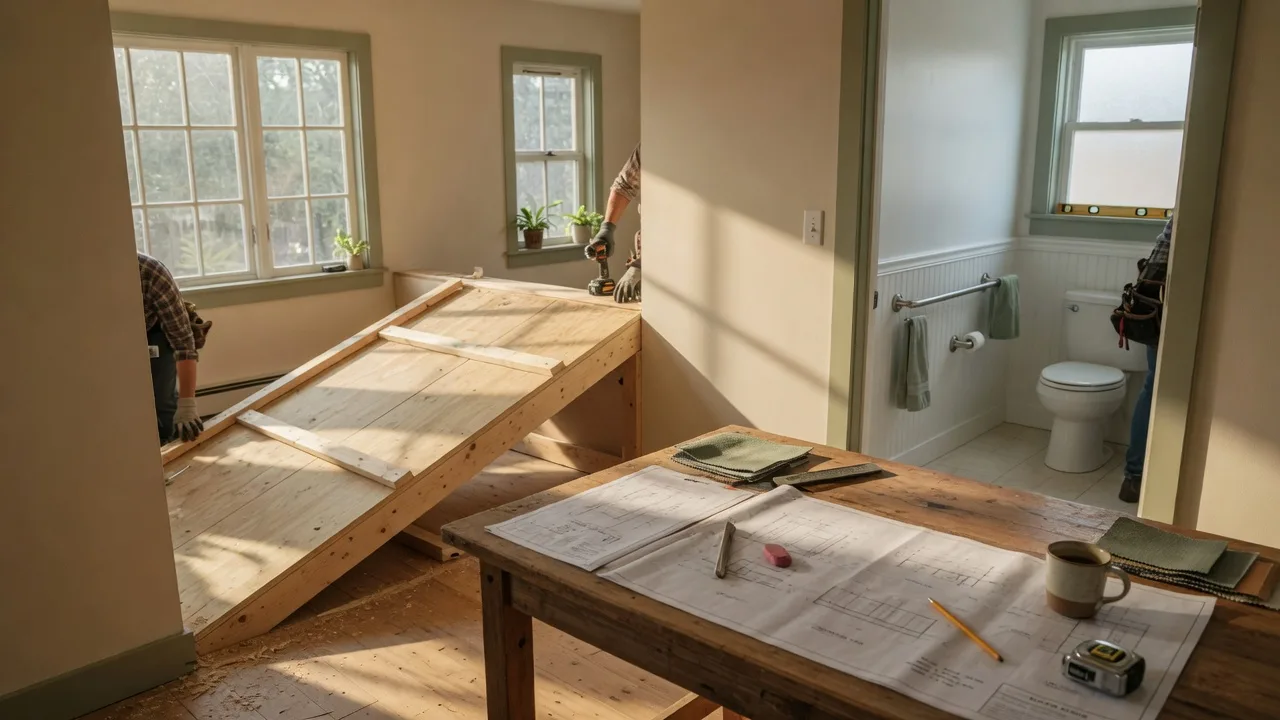
- Wheelchair ramps. Permanent or modular ramps at entry doors for easier access.
- Stair modifications. Stair lifts, chair lifts, or widening stairways for walkers and wheelchairs.
- Doorway widening. Making doorways at least 32 inches wide to accommodate walkers and wheelchairs.
- Zero-step entryways. Eliminating steps at the main entrance for barrier-free access.
- Kitchen modifications. Pull-out shelves, lower countertops, lever-style faucet handles.
Why This Matters for Families
Here is a scenario I see often. A daughter calls me because her 79-year-old father has been diagnosed with early mobility issues. The family home has two steps at every entrance, a tub he has to step over, and narrow doorways. The daughter is worried he will fall. She is also worried about the cost of remodeling.
A reverse mortgage line of credit can address both concerns at once. The father qualifies for a HECM, establishes a line of credit that grows over time, and draws from it as needed to fund each modification project. He pays nothing until he draws the funds, and there is no monthly mortgage payment. The bathroom gets grab bars and a walk-in shower. A ramp goes in at the back door. The doorways get widened. And he continues living in the home he loves, safely.
A Phased Approach Works Best
Because the line of credit allows for draws at any time, families can take a phased approach to home modifications. Start with the most urgent safety improvements, then add more over time as needs change and funds are available. This is much harder to do with a lump sum payment, because the money is taken all at once and the line of credit stops growing.
For families considering this path, I recommend having a conversation with a contractor or an aging-in-place specialist before the loan closes. Get estimates for the modifications your parent may need in the next five years. That way, you can choose a payout option that provides enough flexibility to cover both immediate needs and future projects.
Putting It All Together
What ties these three questions together is a theme I return to again and again: a reverse mortgage is not a one-size-fits-all product. The payout options let families tailor the loan to their own situation. The occupancy rules are designed to accommodate the health realities of aging. And the ability to spend proceeds however they choose gives families real control over how they use their home equity.
The more you understand these practical details, the more you will see that a reverse mortgage is not a last resort or a financial gamble. It is a carefully structured tool that can support exactly the kind of aging-in-place plan most families want, on their own terms and their own timeline.
If any of these questions hit close to home for your family, I would love to talk through your specific situation. There is no obligation, just clear, honest answers about what a reverse mortgage could mean for your parents.
Not Sure Which Option Fits Your Family?
I offer a free, no-obligation consultation to help you and your family understand your options. I hold NMLS #283076 and have helped families across California, Arizona, Colorado, Florida, Texas, and Washington make informed decisions about reverse mortgages. There is no pressure, just clear answers and honest guidance.
Schedule a Free ConsultationDisclaimer: This article is for general informational and educational purposes only and does not constitute financial, legal, or mortgage lending advice. Loan programs, interest rates, terms, and conditions are subject to change and vary based on borrower qualifications. Reverse mortgage proceeds are loan advances, not income, and are not taxable. Eligibility requirements apply. Always consult with a qualified financial advisor, tax professional, or attorney regarding your specific circumstances. Adam Heaney, NMLS #283076, is a Loan Officer at Emery Financial, 3432 Via Oporto, Suite 208, Newport Beach, CA 92663.